Mingmen Industrial Park, No. 7235,Ziyun Road,Economic and TechnologicalDevelopment Zone, Hefei, Anhui Province
By Ecologie Vie Home
July 3rd, 2026
Producing an automatic cat litter box is a multi-stage process that integrates industrial design, mechanical engineering, electronics, and precision manufacturing. Here is a comprehensive breakdown of how these devices are produced, from initial concept to the final product.
Phase 1: Design & Prototyping
This initial phase is where the product’s form and function are defined.
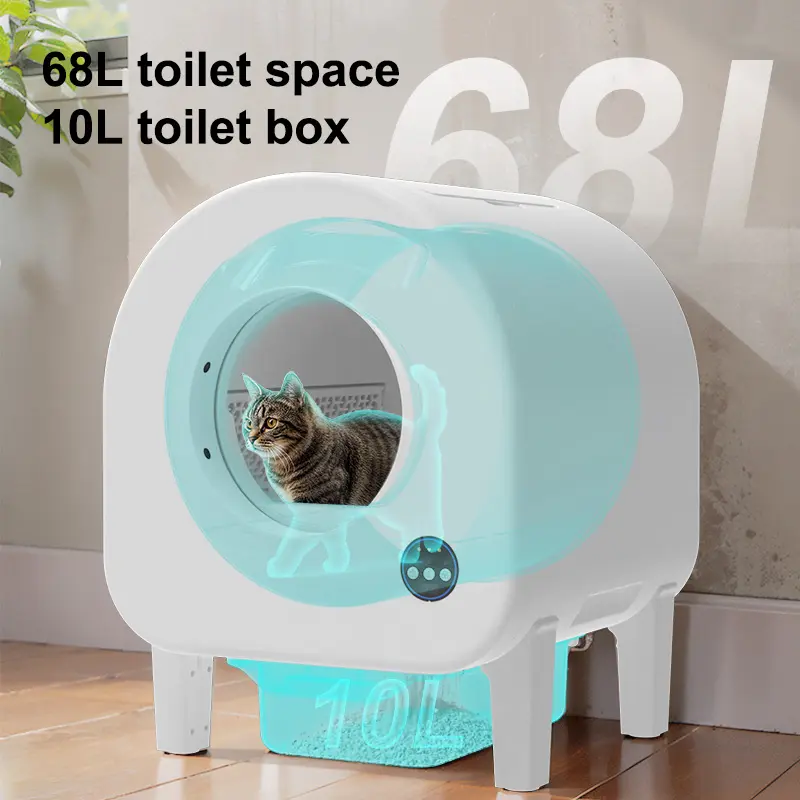
Concept & Mechanical Design: Engineers use CAD software (like SolidWorks) to design the structure-6. This involves planning the mechanism (e.g., a rotating drum or a raking system), the waste compartment, and the overall dimensions (e.g., approx. 540mm x 411mm x 446mm)-6.
Electronics & Firmware: The “brain” of the litter box is developed. This involves:
Microcontroller: Often an Arduino UNO or a custom PCB is used as the central processing unit-6.
Sensors: Weight sensors, motion detectors, and infrared sensors are selected to detect when a cat enters and leaves the box-.
Programming: The firmware is coded to manage the cleaning cycle (e.g., detecting the cat, starting a timer, and activating the cleaning motor)-.
Prototyping & Testing: 3D-printed prototypes are created to test the design, mechanics, and electronics-1. This phase is critical for identifying flaws. For instance, PETLUX had to redesign its base mold after discovering a sealing issue during prototyping-1.
Phase 2: Component Manufacturing
Once the design is finalized, the individual parts are manufactured. This often involves a vertically integrated supply chain-.
A. Plastic Parts (Housing, Drum, Base)
Injection Molding: This is the primary method for creating high-quality plastic components. Molten plastic (like ABS or polypropylene) is injected into a steel mold, cooled, and ejected. Manufacturers like Hangzhou Beiqu integrate this process into their factories-17.
Blow Molding: Used for creating large, hollow, and seamless parts like the main drum or base. As PETLUX describes, it’s “a bit like blowing up a balloon inside a mold” to create a waterproof, one-piece structure-1.
B. Electronic Components
PCBA (Printed Circuit Board Assembly): The electronic circuit boards are populated with microcontrollers, sensors, and other components-1.
Wiring Harnesses: Cables and connectors are pre-assembled to connect the various electronic parts (sensors, motor, control board, power supply)-9.
C. Other Parts
Metal Components: Items like the waste tray or rake are often made from stainless steel for durability and ease of cleaning-1.
Phase 3: Assembly
This is where all the components come together on a production line--9.
Sub-Assembly: Workers or robots first assemble smaller modules, such as the motor-gearbox unit, the sensor array, and the main control board with its wiring-9.
Final Assembly: The main housing is placed on the assembly line-9. Sub-assemblies are then installed into the housing. This includes:
Installing the motor and cleaning mechanism.
Mounting the electronic control board and wiring-9.
Fitting the sensors.
Attaching the drum, waste drawer, and other external parts.
Phase 4: Quality Control & Testing
This is a crucial stage to ensure safety, reliability, and performance-.
Pre-Production Samples: Before mass production, a sample is made and rigorously tested-.
In-Process Inspection: As units move down the assembly line, they are inspected for defects-9.
Final Functional Testing: Every finished unit is powered on and tested. This includes:
Sensor Check: Verifying the weight and motion sensors work correctly-9.
Cycle Test: Running the full cleaning cycle to ensure the motor, raking/rotating mechanism, and waste disposal work flawlessly-9.
Safety & Leak Tests: Checking for electrical safety and ensuring no leaks in the waste compartment.
Certification: Products are tested to meet international safety standards like CE (Europe), FCC (USA), and RoHS–-17.
Phase 5: Packaging & Shipping
The final step prepares the product for the customer.
Packaging: The finished litter box is placed in its retail box, along with power adapters, manuals, and other accessories-1.
Global Distribution: The packaged units are then shipped to warehouses and distribution centers worldwide-9.
In summary, producing an automatic cat litter box is a complex, multi-disciplinary effort that requires expertise in design, electronics, materials science, and manufacturing to deliver a reliable and safe product for pets and their owners.